




Introduction
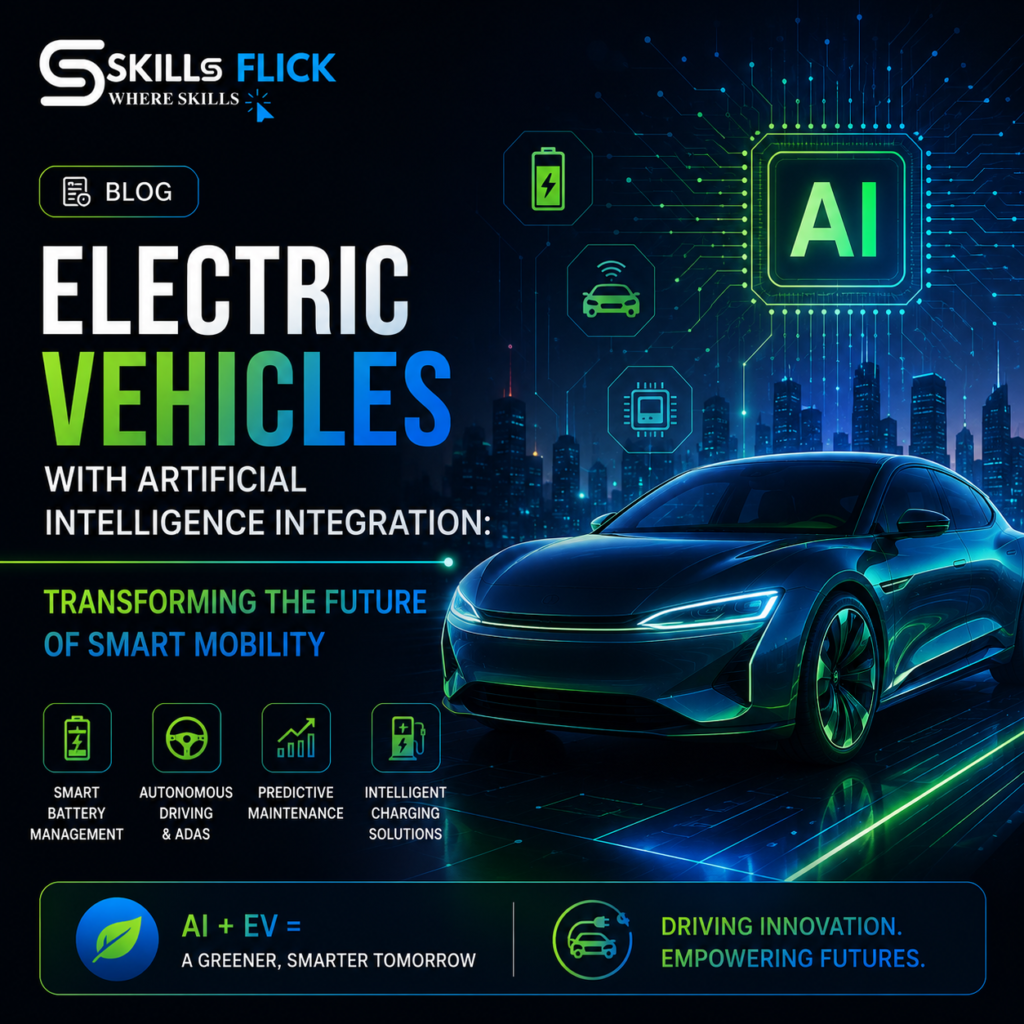
The transportation industry is undergoing one of the biggest technological revolutions in history. Electric Vehicles (EVs) are rapidly replacing traditional fuel-powered automobiles, while Artificial Intelligence (AI) is transforming how machines think, learn, and interact.
When these two powerful technologies combine, they create a new era of smart mobility — a future where vehicles are not only electric but also intelligent, connected, efficient, and autonomous.
AI-powered EVs are changing the way people travel, improving road safety, optimizing energy consumption, and creating a cleaner and smarter transportation ecosystem.
Understanding Electric Vehicles (EVs)
Electric Vehicles are automobiles powered by electric motors using rechargeable battery systems instead of internal combustion engines.
Unlike traditional vehicles, EVs offer:
- Zero tailpipe emissions
- Higher energy efficiency
- Lower maintenance costs
- Reduced fuel dependency
- Environment-friendly transportation
As countries push toward sustainable mobility, EV adoption is growing rapidly worldwide.
However, EVs still face challenges such as:
- Battery performance limitations
- Charging infrastructure issues
- Range anxiety
- Energy optimization problems
This is where Artificial Intelligence plays a major role.
The Role of Artificial Intelligence in EVs
Artificial Intelligence enables EVs to become smarter by analyzing data, making decisions, predicting outcomes, and automating operations.
AI systems use data collected from:
- Sensors
- Cameras
- GPS systems
- Battery monitoring systems
- Driver behavior
- Cloud-based platforms
Using Machine Learning and Deep Learning algorithms, AI continuously improves vehicle performance and user experience.
Core Areas of AI Integration in EVs
1. Smart Battery Management Systems (BMS)
The battery is the heart of an Electric Vehicle.
AI-powered Battery Management Systems help by:
- Predicting battery health
- Preventing overheating
- Optimizing charging cycles
- Increasing battery lifespan
- Improving energy efficiency
AI can also analyze driving behavior and environmental conditions to improve battery performance in real time.
2. Intelligent Energy Optimization
AI algorithms optimize how energy is used inside the vehicle.
By analyzing:
- Traffic conditions
- Road conditions
- Weather patterns
- Driving habits
AI can maximize driving range and improve overall efficiency.
This helps reduce energy waste and enhances the driving experience.
3. Autonomous Driving & ADAS
One of the most revolutionary applications of AI in EVs is autonomous driving.
AI-powered Advanced Driver Assistance Systems (ADAS) include:
- Lane detection
- Adaptive cruise control
- Automatic braking
- Collision detection
- Traffic sign recognition
- Parking assistance
Using Computer Vision and Deep Learning, EVs can understand their surroundings and make intelligent driving decisions.
4. Predictive Maintenance
AI continuously monitors vehicle components and identifies potential failures before they happen.
Benefits include:
- Reduced maintenance costs
- Improved reliability
- Less downtime
- Enhanced vehicle safety
Sensors collect real-time performance data, which AI systems analyze to detect abnormalities.
5. Smart Charging Infrastructure
AI improves EV charging systems by making them more intelligent and efficient.
AI can:
- Recommend nearby charging stations
- Optimize charging schedules
- Reduce electricity costs
- Balance grid demand
- Enable Vehicle-to-Grid (V2G) communication
This creates a smarter energy ecosystem for sustainable transportation.
6. Personalized User Experience
AI enhances the driving experience through personalization.
Features include:
- Voice assistants
- Smart navigation
- Personalized infotainment systems
- Driver behavior analysis
- Real-time recommendations
Modern EVs are evolving into connected smart devices on wheels.
Real-World Applications of AI in EVs
Autonomous Electric Vehicles
Companies around the world are developing fully autonomous EVs capable of self-driving using AI-powered systems.
These vehicles use:
- Sensors
- LiDAR
- Cameras
- Neural networks
- Real-time analytics
to navigate roads safely.
Smart Fleet Management
Ride-sharing and logistics companies use AI-powered EV fleets for:
- Route optimization
- Fuel efficiency
- Driver monitoring
- Predictive maintenance
- Cost reduction
AI helps businesses improve operational efficiency while reducing environmental impact.
Connected Smart Mobility Ecosystems
AI-integrated EVs communicate with:
- Smart traffic systems
- Charging networks
- Smart cities
- IoT devices
This creates seamless and intelligent transportation networks.
Challenges of AI-Integrated EVs
Despite their advantages, AI-powered EVs face several challenges.
High Computational Requirements
AI systems require advanced processors and powerful GPUs for real-time decision-making.
Data Privacy & Security
EVs collect large amounts of sensitive user and driving data, raising cybersecurity concerns.
Infrastructure Limitations
Smart charging stations and connected road infrastructure are still developing in many regions.
High Costs
Advanced AI technologies increase vehicle development and manufacturing costs.
Future of AI-Powered Electric Vehicles
The future of mobility will be driven by intelligent, sustainable, and autonomous transportation systems.
Future innovations may include:
- Fully autonomous EV ecosystems
- AI-powered solid-state batteries
- Integration with renewable energy systems
- Smart city transportation networks
- Real-time edge AI processing
- Hyper-personalized driving experiences
As technology advances, EVs will become safer, smarter, and more accessible.
Conclusion
The integration of Artificial Intelligence into Electric Vehicles is revolutionizing transportation.
By combining clean energy with intelligent systems, AI-powered EVs are solving critical challenges related to efficiency, safety, automation, and sustainability.
This transformation is not only reshaping vehicles but also redefining the future of mobility itself.
The road ahead belongs to smart, connected, and autonomous transportation — and AI-driven EVs are leading the way.
Keywords
Electric Vehicles, Artificial Intelligence, AI in EVs, Smart Mobility, Autonomous Driving, EV Technology, Battery Management System, Sustainable Transportation, Machine Learning, Smart Transportation